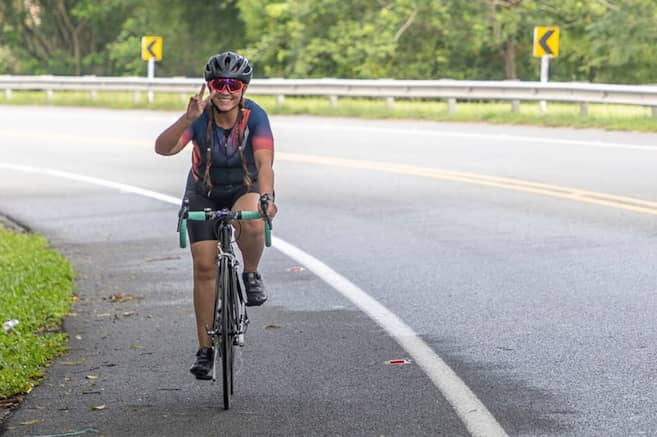

Paula Medina competes in swimming and triathlon adapted for people with organ transplantation. / @Paomedinatx
Photo: @paomedatx
Summary and Fast Informame
Listen to this article
Audio generated with Google
The first blow that Paula Medina received was the death of her sister, just 12 years old. She was 20 when it happened and it was a loss that had no explanation. His parents, healthy and with normal medical history, saw the little daughter of the house leave because of a heart condition whose root was never discovered. The problems began, due to an alleged bacteria, when I had seven. Thus, as a young man, he had to receive a heart transplant that his body could not tolerate and, five years after having started a fight for which they were not prepared, he died.
There began the ordeal. Two years before her sister died, Medina began to feel strange things in her chest. She, a high performance athlete, got tired when she had to make cardio in her trags of Porrismo, the dream she fell in love with when she was a teenager. Given the effort, his chest hurt unbearable, but she endured, and did it for years, until her sister died. It was then that he told his parents what he felt and the exams, that they took him immediately, revealed that he had dilated heart disease, the same thing that had taken the little girl of the Medina; A disease in which the heart enlarges and weakens, losing its ability to pump blood efficiently. The doctors told them that it should be a terrible coincidence or that their family, despite having no history, had inherited the condition that life would change.
His heart, and his spirit, began to go out little by little, with a lazy and tired rhythm. A contrast of hyperactivity that had taken her, being a girl, to get involved as soon as she crossed her in front: she became champion in both basketball and bowling, but it was the porrists who managed to recruit her when she was in school. Since then, the dream of being one of the pioneers of that sport in Colombia, a discipline, especially popular in the United States, the great goal that Paula Medina could not fulfill.
After his diagnosis, with the traumatic family experience he had lived, he was very afraid to accept a heart transplant, but the fear of feeling his life was greater and when he found the courage to accept the donation, which gave him a new vice, he was born again with a new purpose: to love life again and promote the donation of organs.
Recover again and again
Paula today lives with another heart. He remained athlete after the operation and, in fact, the sport opened the doors to his new life. Currently, it is prepared with the Colombian selection of transplanted athletes who will travel to Dresden (Germany), to participate in the 25th edition of the WTGF World Games (World Transplant Games Federation). Thirteen national athletes (three women and 10 men) will participate in multiple disciplines, but the Antioqueña will be in triathlon and swimming in open waters, competitions in which he already participated, achieving a bronze medal in the World Games that took place a few years ago in England.
The certainties of the now were confusion in yesterday. Before imagining the opportunity to be a athlete, Paula Medina doubted, many times, if he would continue to live. When he finally accepted his illness and was prepared to receive the transplant, an unexpected stumble stole his mood: doctors told him that he needed not only a heart, but also new lungs. The reason? A severe pulmonary hypertension that could damage the new organ. The doctors considered both procedures too risky and with little chances of success. The difficulty was not only the diagnosis, but the conditions that accompanied it: a sick heart is not enough to be considered suitable if the rest of the body cannot sustain it. Pulmonary hypertension made the procedure an extreme risk, because any new heart would have quickly failed in the face of high blood pressure in the lungs. In addition, the organs do not arrive when one awaits them: time is uncertain, but not deterioration. And in the meantime, to be a candidate, she had to stay stable, without added complications.
In Colombia, according to INS figures (National Health Institute), receiving an organ remains a distant possibility for thousands of people: at the end of 2022, more than 3,600 patients were on the waiting list and only 1,190 transplants were performed throughout the country. Although the figures show a recovery after the pandemic – with an increase of 21.1 % compared to 2021 and an improvement in the number of cadaveric and living donors – reality remains complex. The most demanded organ is the kidney, with 3,328 people waiting for one, followed by the heart, of which only 80 patients were transplanted. The donation rate remains low: just 6.4 donors per million inhabitants, which limits access to vital procedures and reveals the urgency of promoting altruistic donation and strengthening public health policies that prevent the deterioration of organs such as kidney, liver and heart.
And if the situation was already complex, in the midst of that panorama, Paula Medina was about to lose a leg, because while she was struggling to stay stable, with her heart disease, her heart was filled with thrombi. One of those clots traveled to the artery of his right leg, obstructing it completely. The doctors tried to clean it several times, but they did not succeed, and began to necrose. As a last resort, they made a bypass: a surgical bridge to recover the circulation. Although the procedure was also complicated, and the pain became chronic, it managed to keep the leg.
In the midst of uncertainty, sport and his childhood love opened a slit to hope. First, as silent therapy, swimming allowed him to gradually recover the lung function and stabilize his body. Luckily, the training made her feel alive again. It was in the water where he convinced the doctors that he still had strength, where his heart resisted and his lungs improved, to the point that one day they told him that he no longer needed the double transplant. Only then could he go on a list to receive a new heart. And it was also swimming where he met the triathlon, his second life.
A new heart
Paula Medina remembers chest sensation. His new heart was beating so hard that he felt he was going to get out. Given the disbelief, of feeling alive – with a heart that pumped blood to full machine – he asked his mother to prove that his body was real. His new organ changed him to the most insignificant things; To be able to go to bed without a pillow that will leave her sitting all night, breathe normally, drink water directly from a bottle – after years of learning to swallow sips mixed with saliva. They were simple gestures that became celebration rituals. Each beat was a confirmation: everything started again.
It was at that time, still in recovery, when one of his doctors threw a phrase that shook her: “You have a new heart. Don't complain; take advantage.” And he did. With the triathlon a life purpose was born: compete and take its history for the world. It was no longer just training again, but demonstrating that a transplanted body can also cross goals. The sentence ignited a flame. If I had a second chance, I would not miss it. Thus he started swimming, then running and riding a bicycle. Little by little, a new athlete was built, with a foreign heart that was beating more force than ever. The Latin American games, the Oceanman, the Ironman and the World Games, which he hopes to repeat in August of this year arrived.
Paula Medina was reborn, but was also about to die again. After her transplant, she faced physical pain and emotional abysses that led her to the limit. In 2022, his body suffered a severe rejection of the transplanted organ – a common reaction, as she explains, that happened to her when the body recognized that this heart was not his. The situation was so critical, so devastating in the physical and mental, that Paula requested euthanasia as a solution to its exhaustion. He felt deeply defeated. However, the treatments worked. And eight months later, against all forecast, I was again in the water, completing a 5,000 -meter Oceanman. It was the sport, as so many times in his life, which sustained it: not only kept her trained to resist, but offered her a goal when everything else seemed cloudy.
That is why he likes to tell the story when he won bronze in the last world games in the 50 meters butterfly. Third place was very frustrated, I wanted gold. But, up on the podium, so many memories and so many struggles came to mind, that nostalgia beat pride. And then he remembered how much that medal deserved and what he represented to be there, after all. It was not any bronze: it was the prize for having survived. He understood that his place in that partner was the biggest victory. “I am here because I struggled for my life,” he recalls today and says that, since then, that medal, which he did not want, became the most treasured.
Paula Medina understood that her purpose went further. Therefore, in addition to competing, it carries an urgent message in the world: that of organ donation as an act of love that saves lives. He does it taking care of transplanted children, leading the national team, managing resources so that others can compete and teaching those who have received an organ to love each other is also a way of resisting. He tells them with the authority of those who have lived in their own flesh the fear, pain, hope and glory. She knows it well: her heart, brave, forged with each blow. The first, the death of his sister. That marked its story, because it continues to drive it to swim, run, pedal and, above all, move on.
🚴🏻⚽🏀 The latest in sports?: Everything you should know about world sport is in the spectator